 RankedContent
Is SEO dead in 2026? What the data actually says
SEO in 2026 is a channel with flat aggregate traffic and a wildly uneven distribution. Organic traffic across the 40,000 largest US sites barely moved last year. The smallest publishers absorbed most of the damage. Zero-click searches reached 68.01% of US Google queries in early 2026[1]. Those numbers are real.
- The market-wide organic traffic number and your traffic number are different animals. One barely moved. The other depends on which segment you sit in.
- Search still out-delivers every AI assistant on raw referral volume. Google remains the traffic engine by a distance most teams underestimate.
- Most AI product recommendations trace back to search rankings, so the AI layer rides on the ranking layer instead of replacing it.
- Pages cited inside an AI Overview earn back a large share of the clicks that uncited pages lose on the same query.
- Off-site brand mentions predict AI visibility better than domain rating or page count. Publishing volume barely registers.
Organic traffic across 40,000 US sites fell 2.5%, not 40%
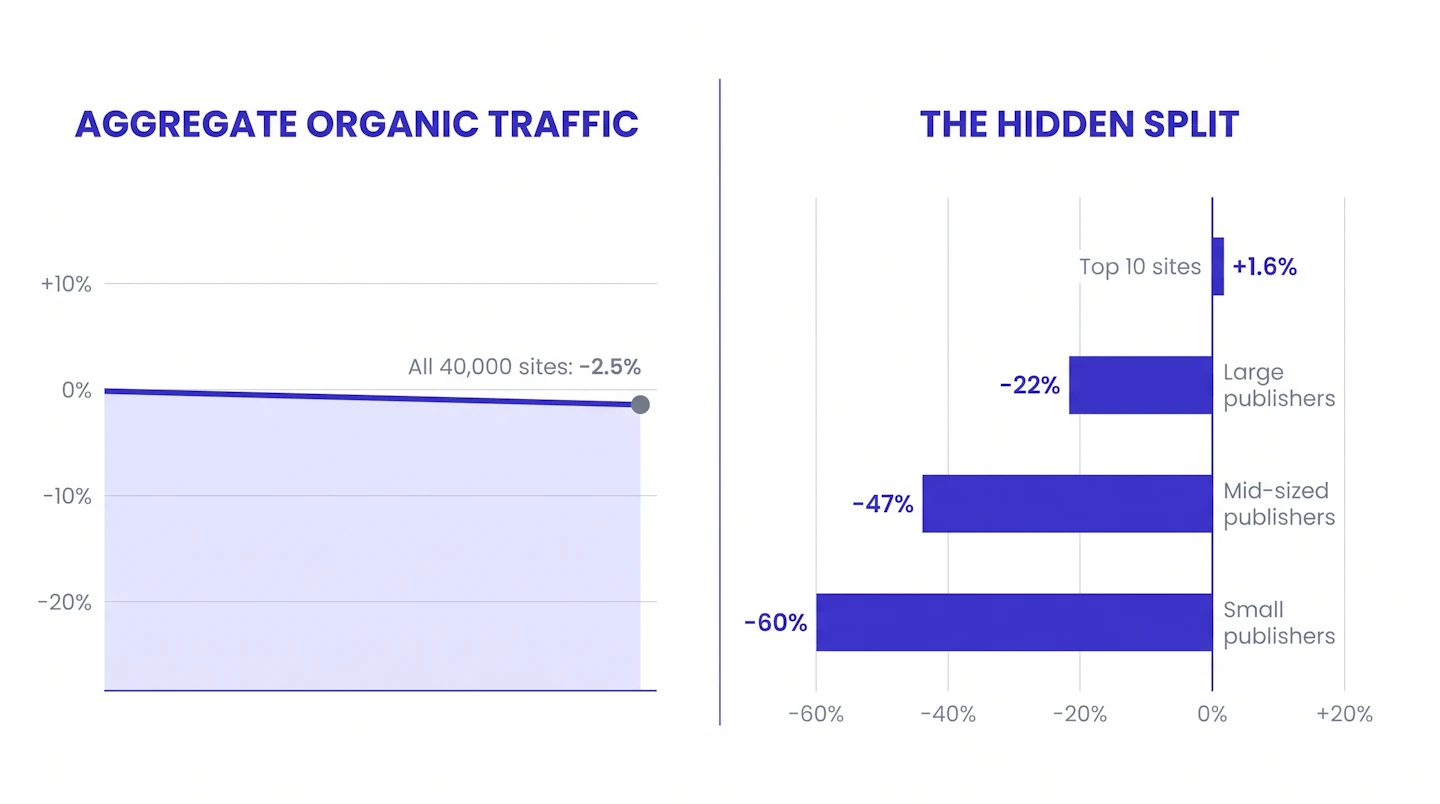
Start with the number nobody quotes. Graphite, working with Similarweb panel data, measured organic traffic across more than 40,000 of the largest US sites. They compared February to December 2024 against January to November 2025. The drop was small enough to disappear inside the noise on most dashboards. Traffic to Google itself rose 0.8% over the same window.
That figure sits awkwardly next to the panic. It also comes with a disclosure worth respecting: Ethan Smith runs an SEO agency, and he says so in the piece. But read the method, not the byline. The panel was validated against Google Search Console data with a median Pearson correlation of 0.86, which is a tighter check than most agency studies bother with.
The click-level damage is real, but it is narrower than the headlines suggest. Ahrefs compared 150,000 keywords carrying an AI Overview against 150,000 informational keywords without one, using aggregated Search Console data. The top-ranking page took a 34.5% lower average clickthrough rate when an AI Overview sat above it[3]. Painful. Also confined to the queries where the answer box fires.
And that firing rate moves around. Semrush tracked 10 million keywords through 2025. AI Overviews appeared on 6.49% of queries in January, peaked at 24.61% of queries in July, then fell back to 15.69% by November[4]. Google tunes this dial constantly. Any plan built on a single month's prevalence number is built on sand.
Small publishers lost 60% of search referrals while the largest sites grew 1.6%
Here is where the aggregate stops being useful. Chartbeat segmented its client base by size and measured search referral changes over two years, reported by Axios in March 2026[5]. The smaller the publisher, the harder the fall.
Mid-sized publishers came off better, and only just. Brutal, and survivable for a business with other channels feeding it. The pattern holds across every size tier, which rules out a handful of unlucky sites dragging an average around.
| Site segment | Change in search traffic | Measurement source |
|---|---|---|
| Top 10 US sites by traffic | +1.6% | Graphite / Similarweb, Jan 2026[6] |
| Large publishers | -22% | Chartbeat, two-year window |
| Mid-sized publishers | -47% | Chartbeat, two-year window |
| Small publishers | -60% | Chartbeat, two-year window |
Large publishers had a bad year, not an extinction event. Scale bought them a buffer: direct traffic, apps, newsletters, and the brand recognition that keeps a name in the answer even after the link disappears.
At the very top, traffic grew. The ten largest US sites finished the Graphite study window ahead of where they started. Whatever pressure the answer box applied, it did not reach them.
Search did not shrink. It consolidated. The market average now describes a website that does not exist.
RankedContent analysis
The split runs by vertical too, not only by size. Conductor analysed 21.9 million Google searches across 13,770 domains. AI Overviews fired on 48.75% of Health Care queries and 4.48% of Real Estate queries[7]. A health publisher and an estate agency live in different search markets that happen to share a URL bar.
"Publishers face new competition from AI answer engines and next generation browsers that are able to summarise and remix content."
Newman's survey ran across 280 media leaders in 51 countries, including 64 editors-in-chief. The competition he names is not only the answer box. Agentic browsers now read a page, summarise it, and hand the reader a conclusion without a visit. That is a second leak in the same pipe.
Google sends 190 times more referral traffic to websites than ChatGPT
Now the part that gets lost in the noise. If SEO were dying as a traffic channel, AI assistants would be picking up the slack. They are nowhere close. Ahrefs measured referral traffic across 76,000 websites in February 2026 using its own referral data[9].
Google's share of all web referral traffic sits comfortably in the high thirties. ChatGPT's share rounds to a fifth of one percent. Put those two figures side by side and the migration story falls apart. Answer engines took attention. They haven't taken the traffic with them - at least, not yet.
| Measure | ChatGPT | |
|---|---|---|
| Share of all web referral traffic | 39.98% | 0.21% |
| Estimated click-through rate | 29.2% | 1.3% |
| Daily queries or prompts | 13.7 billion | 2.5 billion |
| Referral traffic multiple | 190x | 1x |
The click-through gap explains the traffic gap. An assistant's click rate lands near the floor, a search page's near a third. People arrive at a chat window expecting an answer, not a list of doors to open. Even a badly degraded results page pushes far more people outward.
Prompt volume tells a warmer story than the traffic figures do. Ahrefs puts the search-like slice of ChatGPT usage at roughly 12% of Google's search volume, and that share climbs every quarter. Demand is moving. Clicks are lagging behind it, which is why brands feel a loss their reports cannot fully account for.
The multiple at the bottom of the table is the number to carry into your next planning meeting. Any budget shifted out of search on the assumption that AI referrals will replace it is a budget moved from a river to a stream.
Roughly 80% of AI recommendations trace back to search rankings
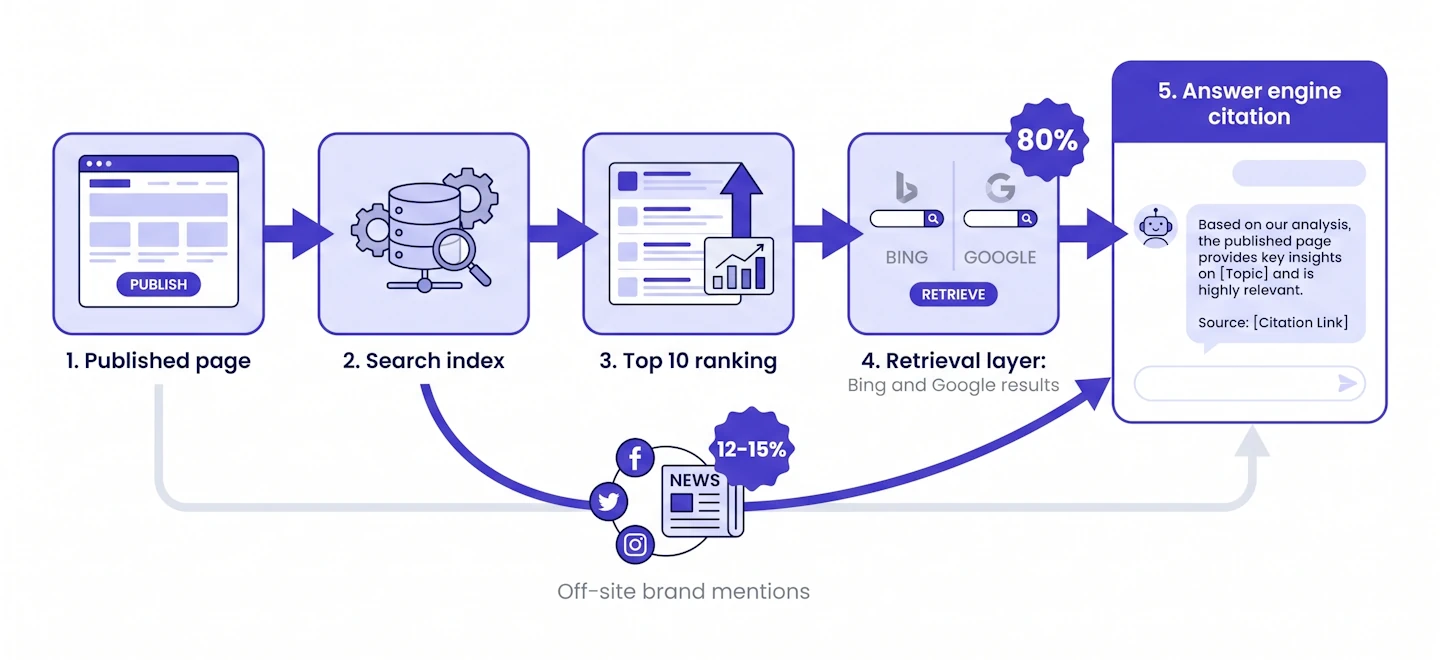
So why does ranking still matter if the answer engine writes the answer? Because the answer engine does not know anything about your product. It runs a search and reads what comes back.
Maestra ran the most granular test of this I have seen. They fired 79 prompts three times each across ChatGPT Plus, ChatGPT Business, and Gemini, spanning three model generations, and parsed more than 13,000 citations from over 370,000 search results. The finding: roughly 80% of AI product recommendations trace directly back to search rankings[10].
The plumbing shows through in the details. ChatGPT Business labelled 95% of its search citations as Bing, and 94% of those citations came from the top 10 results. The consumer tier leaned on a Google scraper and reached further down the page, into the low twenties, with 59% of citations from the top 10. Same model, different retrieval backend, different odds for your page.
Format decides what happens after retrieval. In Maestra's runs, listicles cited by the model had their first item picked at 1.7 to 2.5 times the rate chance would predict, and the top five items accounted for 76% to 81% of all selections. Pages carrying tables gained 19.7 percentage points on the Google-backed condition. Numbered lists added 10 to 11 points. A model skims like a hurried reader, and it rewards the same structures a hurried reader rewards.
None of this is speculative. The paper that named the discipline, GEO: Generative Engine Optimization by Pranjal Aggarwal and colleagues, was accepted to KDD 2024. Adding citations, quotations, and statistics to a page can boost visibility by up to 40% in generative engine responses[11]. Fact density is a ranking signal for machines the way backlinks are for crawlers. For the difference between the three disciplines, I broke it down in SEO vs AEO vs GEO.
The academic paper that coined the term GEO landed in 2024, two years before most brands started budgeting for it. The playbook was published while the industry was still arguing about the shape of the game.
Aggarwal et al., KDD 2024[11]
Cited pages earn 120% more organic clicks per impression than uncited pages
Citation pays, and it pays in ordinary clicks. Seer Interactive tracked 53 brands, 5.47 million queries, and 2.43 billion organic impressions from January 2025 through February 2026. They split the results by one variable: did the AI Overview name the brand or not?
Read the second half of that finding too. A cited page still underperforms the same query with no AI Overview present by 38%. Citation recovers most of the loss. It does not erase it. Anyone promising that GEO makes you whole again on informational queries is selling something.
This is the metric worth wiring into reporting, and most teams cannot report it. Rankings tell you where a link sits. Citation share tells you how many times a machine hands your name to a buyer. The two now diverge on the same query, which means a green ranking dashboard can sit on top of a collapsing pipeline. RankedContent scores pages against both layers, because a page can rank beautifully and still be unquotable.
Off-site brand mentions predict AI visibility better than domain rating
One layer sits outside the ranking pipeline, and it is the layer most SEO teams have no budget line for. Ahrefs ran a Spearman correlation analysis across 75,000 brands in December 2025, testing which signals track with visibility in ChatGPT, AI Mode, and AI Overviews.
YouTube mentions show the strongest correlation with AI visibility at roughly 0.737[13]. Branded web mentions followed at 0.66 to 0.71. Domain rating, the metric half the industry still optimises toward, came in around 0.29. Number of site pages sat at 0.194, close to noise. Publishing more did almost nothing.
Correlation is not causation, and the Ahrefs team says so plainly. Big brands get talked about on YouTube and get mentioned by models, and both facts share a parent cause. The directional read still holds: models are trained and grounded on a corpus where your brand is either discussed or absent.
An earlier Ahrefs pass on the same 75,000-brand set put a size on the gap. Brands in the top quartile for web mentions averaged 169 AI Overview mentions. The next quartile down averaged 14. A tenfold cliff between neighbours, which explains why entity work now beats another content sprint. I covered those mechanics in What is AEO.
26% of brands have zero mentions in AI Overviews. Not low visibility. Zero. For a quarter of the market, the AI layer has not started yet.
Ahrefs, analysis of 75,000 brands[14]
What changes for a working SEO programme?
The verdict depends on which sentence you finish. Search as a traffic channel is intact and still dwarfs every alternative. Search as a reliable delivery system for thin informational pages is finished, and it is not coming back.
Three things move the needle now. Rank first, since the retrieval layer reads from the top of the results. Structure second, because tables and numbered lists get lifted while prose gets paraphrased. Get mentioned third, off your own property, in the places models read.
Watch the segment you actually occupy, and ignore the market average. A health care brand and a real estate brand read the same industry reports and face completely different exposure. Pull your own numbers by query type, then decide what to cut.
The word for this state is bifurcation: one channel splitting into two paths with opposite fortunes. The programmes struggling in 2026 are the ones still measuring a single path.
Frequently Asked Questions
Is SEO dead in 2026?
SEO is not dead in 2026. Search still sends more referral traffic to websites than every AI assistant combined, by a wide margin. What died is the assumption that a page ranks, gets clicked, and the job ends there. Ranking now feeds two outcomes: clicks and citations.
Why did my organic traffic drop if aggregate search traffic is flat?
Averages hide the split. The aggregate number pools the largest sites in the market with everyone else. Large brands held their traffic. Smaller publishers and thin informational pages took the loss. If your pages answered simple questions, an AI summary now answers them first.
Does ranking in Google still help me get cited by ChatGPT?
Yes. Answer engines run live searches and quote from what those searches return. ChatGPT builds most product answers from Bing or Google results, so a top ten position puts your page in the pool the model reads from. Ranking is the entry ticket to citation.
What is the difference between SEO, GEO and AEO?
SEO earns positions in a ranked list of links. GEO, or Generative Engine Optimization, earns mentions inside AI-generated answers. AEO, or Answer Engine Optimization, structures a page so a machine can lift a clean answer from it. The three share one retrieval layer underneath.
How much traffic do AI answer engines actually send?
Very little compared with search, though it converts well. AI referrals sit near one percent of total website traffic for most brands. The value shows up earlier in the buying cycle, as a mention that shapes a shortlist, not a session in your reports.
Should I stop publishing informational content?
Stop publishing informational content that a model already answers well. Keep the pieces that carry proprietary data, original testing, pricing detail, or a named practitioner's judgment. Those pages get quoted instead of replaced, and they pull the branded searches that feed everything else.
How do I measure AI search visibility?
Track citation share on your own category prompts, not rankings alone. Run the same prompts on a fixed schedule across the assistants your buyers use. Count how many answers name your domain, which page gets quoted, and which competitor holds the slot you want.
The honest answer, in one line
Anyone answering the death question with a single number is answering a question you did not ask. Your exposure depends on your vertical, your size, your query mix, and the share of your pages carrying something a model cannot generate on its own. Pull those four numbers. The verdict follows from them, and it will not match the headline.